In this article
An arithmetic check can identify a question. It cannot determine which time is payable, whether a break is valid, or whether a service was authorized.
Start with the same unit
Time can be displayed as hours and minutes or as decimal hours. Ninety minutes equals one hour thirty minutes and 1.5 decimal hours. It does not equal 1.30 decimal hours. Before comparing two quantities, determine the unit and whether the system has applied a documented rounding rule. This article supplies no program-specific rounding policy.
A fictional overnight example
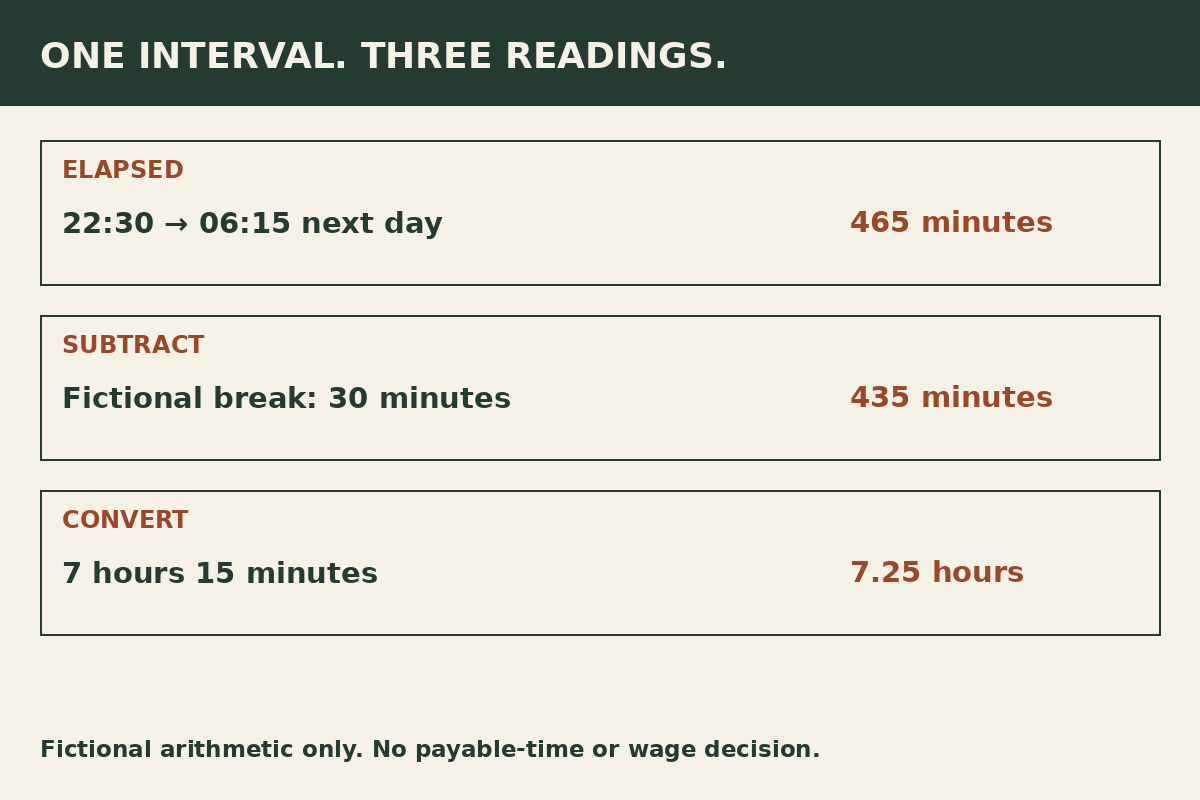
Start: 10:30 p.m. End: 6:15 a.m. the next day. Elapsed clock time is 7 hours 45 minutes, or 465 minutes. Subtracting a hypothetical 30-minute break produces 435 minutes, or 7 hours 15 minutes, or 7.25 decimal hours. These are arithmetic values only, not an approved shift or a wage calculation.
The local duration worksheet reproduces this example. It requires an explicit next-day choice so an end time earlier than the start is not silently treated as overnight. It accepts no name, service date, participant detail, rate or account information. Its result remains on the current page.
Know the worksheet’s limits
The worksheet handles one interval shorter than 24 hours and a break duration within that interval. It uses clock times, not dates or time zones. It cannot account for daylight-saving changes, a shift spanning multiple days, multiple service categories, travel rules or paid-break rules. On a clock-change date, use actual dated records and official instructions rather than this simplified arithmetic.
Subtracting an entered break does not establish that the break should legally or administratively be unpaid. The worksheet does not determine compensable hours, overtime, minimum wage, tax, benefits or the amount due. It is a neutral subtraction exercise.
Then compare the record’s meaning
A scheduled shift, recorded visit, submitted timesheet, approved quantity and statement line may describe different stages or concepts. Match the date range and field definition before comparing the numbers. If one record uses minutes and another decimal hours, convert units first. If one records an entire visit and another a service category, do not assume their scopes match.
Official Washington resources separately list time-entry, mileage and paystub materials. That separation is a useful reminder to select the guide that actually describes the record. It is not evidence of any particular person’s approval state.
Preserve the observation
A helpful note says that two named fields differ under a stated comparison. It does not guess that software rounded incorrectly, a reviewer rejected a shift or payroll missed a deadline. Ask the authorized program contact which input and rule produced the value. Continue with the correction-question guide when the difference is specific.
Sources and limits
Official public sources checked October 18, 2026. Practical examples and reading methods are original editorial analysis, not official procedures. No private account or visit record was inspected.
- Washington caregiver resources
Washington-specific public directory: payroll calendar, time and mileage guides, paystub resources and CareAttend materials. No individual record or current numerical deadline is established here.
- DirectMyCare training materials
Training materials grouped by state and caregiver or participant role. The applicable guide depends on program and role.